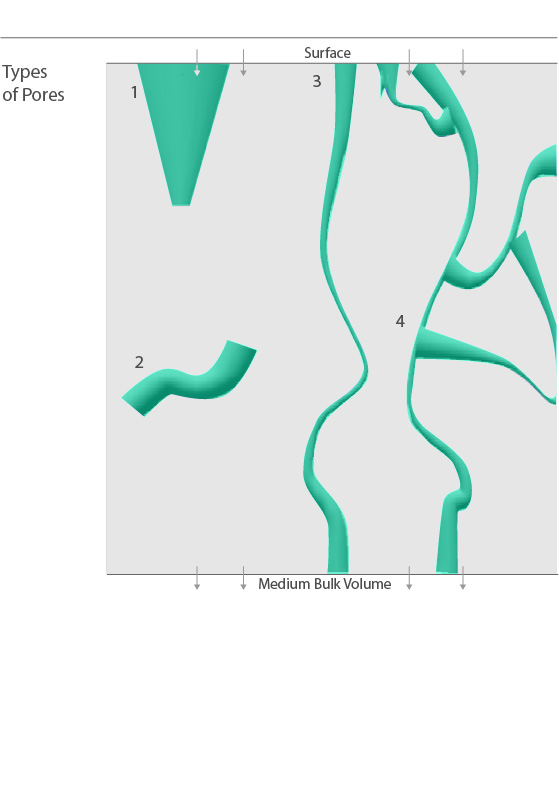
In porous plastics, pores are the solid surface openings through which gases, liquids, and smaller particles can flow. The morphology—size, shape, spatial arrangement, and connectivity of these pores—can significantly impact the movement of particles throughout a porous media. This article will outline the various types of pores, including their accessibility, impact on flow efficiency, measurement, and applicational implications.
Pore Connectivity and Porosity
Flow within a porous media can be achieved only through a process of interconnectivity, meaning if a pore is not accessible from one or more ends, particles will fail to reach the bulk volume of the medium adequately. Closed porosity, also known as internal porosity, measures these void spaces that are not contributing to flow. The four types of pores are illustrated in the graphic to the right. They can be classified as blind pores (1), which are accessible only from one end, or isolated pores (2) which lack accessibility altogether. In contrast, interconnected pores (3 & 4) allow particle flow to occur from the surface all the way to the medium’s bulk volume. Open porosity, often called interconnected or effective porosity, is the measure of the pores contributing to actual flow, which is critically important in facilitating applications such as wicking and absorption, among others. Even for interconnected pores, however, overall efficiency can be heavily influenced by pore distribution, size, and tortuosity. Tortuosity is the geometric complexity of the interconnected pore structure. As illustrated to the right, pores with multiple ends (4) will exhibit higher levels of tortuosity, allowing flow to occur, but often with greater transit difficulty and time delay relative to more direct paths (3).